Looking for guidance?
Medical writing involves creating engaging content for continuing medical education, abstracts for journal articles, regulatory documents, and more.
Here at Write Medicine, we help academics, clinicians, and researchers from all backgrounds learn how to break into CME medical writing and become CME writers.
Join your CME medical communication peers in shaping the healthcare industry one CME course at a time.
From AI to gender equity in healthcare, start your professional journey as a CME writer today with the Write Medicine blog.

How to Raise Your Freelance Medical Writing Rates This Year
Raising your rates is not just a confidence exercise. It’s a business decision. This blog walks freelance continuing medical education writers through how to tell when their pricing no longer fits, what their work is actually costing them, why tax season can reveal underpricing, and how to raise rates in a way that supports a more sustainable business.
How to Be a CME Writer: 3 Lessons From My First Freelance Writing Gigs
I became a CME medical writer the way most people do — sideways, with no roadmap. When I started freelancing, I was a former clinician and academic who needed to work. I cycled through substantive editing, book manuscripts, whitepapers, and general medical writing before landing in CME writing — not because someone pointed me there, but because I ran out of wrong doors. Now, years into building a CME writing career, I created WriteCME Pro so no one else has to wander the way I did.

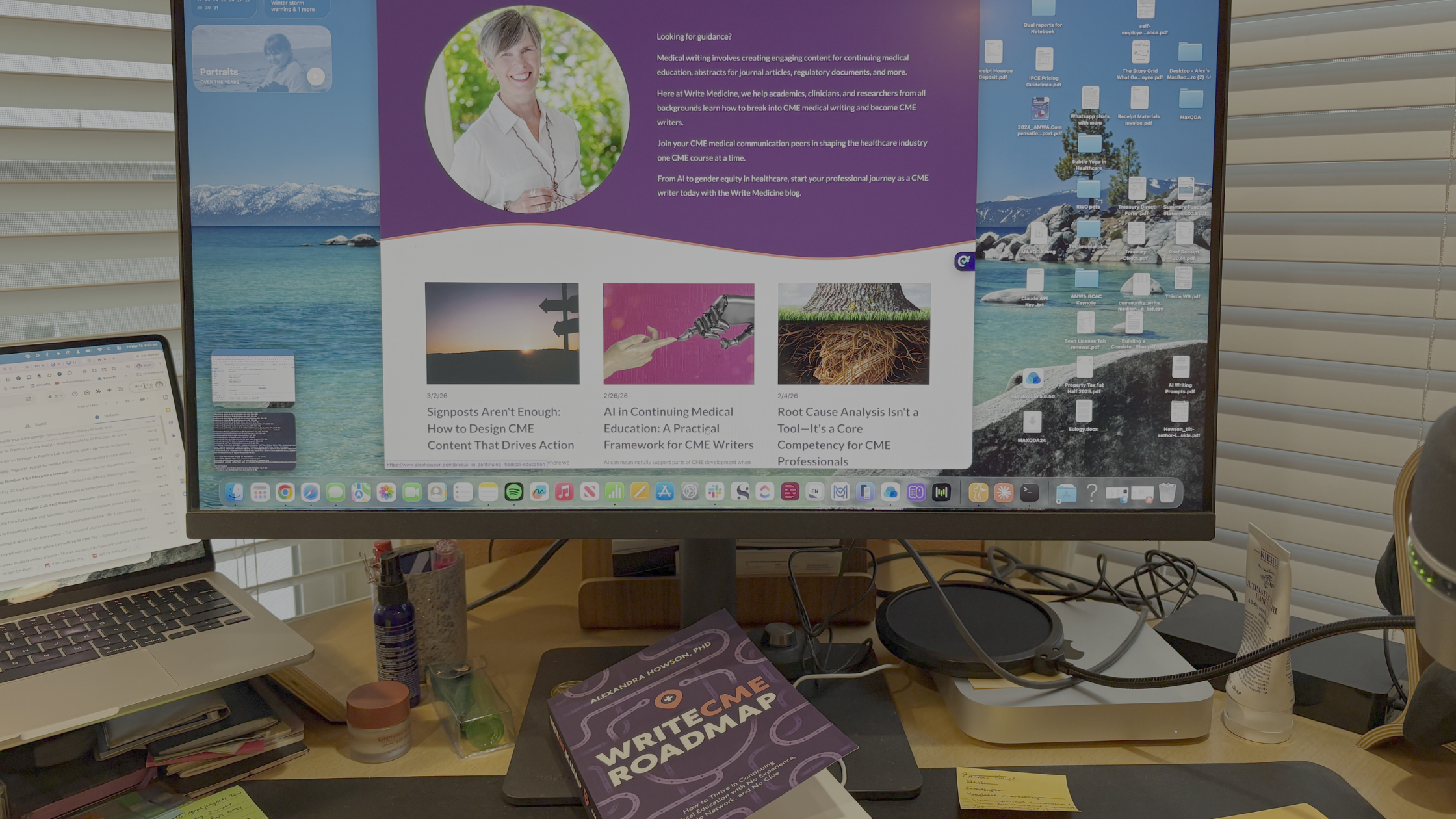
Signposts Aren't Enough: How to Design CME Content That Drives Action
Learning objectives are the signposts that tell us where we want our learners to end up — but it’s rarely as simple as designing content for outcomes. We also have to design it for behavior change, with concrete actions to help learners apply new knowledge.

AI in Continuing Medical Education: A Practical Framework for CME Writers
AI can meaningfully support parts of CME development when paired with clear parameters and human oversight. This framework covers where AI earns its place in a CME medical writer's workflow, where compounded expertise is irreplaceable, and how to build a defensible AI strategy your clients can trust.

Root Cause Analysis Isn't a Tool—It's a Core Competency for CME Professionals
If RCA has ever felt underwhelming or overly mechanical, it's likely because no one taught you how to use it strategically.

Know Your Audience: Your Superpower for Creating CME Content That Connects With Different Learners
Great CME doesn’t start with a job title—it starts with understanding the real-world context your learners work in. From patient populations and care settings to time pressure and resource constraints, effective CME reflects the realities clinicians face every day. This blog explores how empathy-based audience analysis can help CME writers design education that feels relevant, practical, and worth a clinician’s time.

What 2025 Taught Us About CME Writing—and What It Demands of Medical Writers in 2026
In 2025, CME didn’t just adapt—it recalibrated. AI expectations rose, timelines compressed, and the evidence pipeline itself became harder to trust as key research and public health resources were altered, restricted, or removed. For CME writers, these pressures aren’t abstract: they’re changing what clients need and what writers must bring—judgment, transparency, and strategic partnership. Heading into 2026, the differentiator won’t be output alone, but the ability to contextualize uncertainty, make reasoning visible, and protect the capacity to do high-integrity work.